Join us for DataOps Day Atlanta on August 21. Register Today >
Download the Gartner® Hype CycleTM for Discrete Manufacturing Technologies, 2026 to better understand the value and maturity of emerging technologies like Industrial Data Management to identify and prioritize your investments.
Mass customization, servitization, and shifting supply-and-demand dynamics are reshaping discrete manufacturing.
We’ve found that the Hype Cycle for Discrete Manufacturing Technologies helps organizations cut through the noise and make informed decisions for sustained cost optimization and competitive advantage. It is considered a critical decision support tool for operations and IT leaders, providing a structured framework for evaluating the adoption rate and business impact of current technologies and disciplines. This helps prioritize initiatives that align with both immediate operational needs and long-term strategic objectives.
Leverage the model in this report to learn about the maturity, business impact, obstacles, and user recommendations for technologies like Industrial Data Management.
In this report, Industrial Data Management (IDM) is defined as the practice of organizing industrial data by tagging, classifying, normalizing, contextualizing, and transforming raw OT datasets into meaningful semantic data objects. It blends large volumes of IT and OT data to ensure consistency, interoperability, and AI readiness for asset-intensive industries such as manufacturing, energy and utilities, and logistics.
IDM is important because industrial data is complex, unstructured, and highly abstract for AI models and visualization to gain insights. IDM refines and structures operational technology (OT) data so it can be reliably visualized, analyzed, and used to train AI models without errors or hallucinations. This foundation enables asset-intensive enterprises to modernize operations and unlock future opportunities from advanced and agentic AI.
Gartner views IDM’s maturity as an “Early Mainstream” market with a “Transformational” benefit rating and names HighByte as a Sample Vendor.
Digital threads, autonomous AI-driven operations, and efficiency and resilience are the core strategic realities shaping this year's Hype Cycle. Industrial Data Management remains foundational, enabling manufacturers to unify production data, support Industrial AI initiatives, and scale emerging technologies such as agentic AI and digital threads.
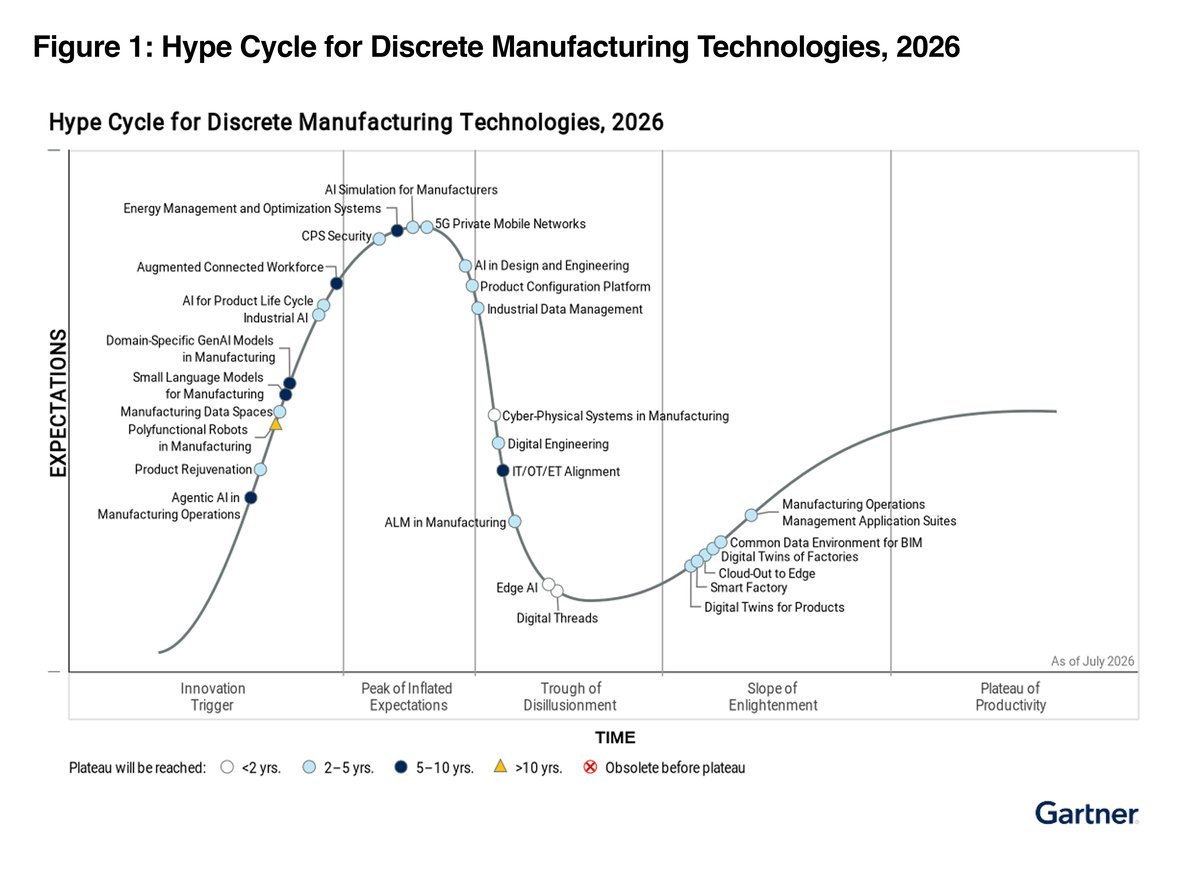
Gartner Hype Cycles provide a graphic representation of the maturity and adoption of technologies and applications, and how they are potentially relevant to solving real business problems and exploiting new opportunities. Gartner Hype Cycle methodology gives you a view of how a technology or application will evolve over time, providing a sound source of insight to manage its deployment within the context of your specific business goals.
Innovation Trigger: A potential technology breakthrough kicks things off. Early proof-of-concept stories and media interest trigger significant publicity. Often no usable products exist and commercial viability is unproven.
Peak of Inflated Expectations: Early publicity produces a number of success stories—often accompanied by scores of failures. Some companies take action; many do not.
Trough of Disillusionment: Interest wanes as experiments and implementations fail to deliver. Producers of the technology shake out or fail. Investments continue only if the surviving providers improve their products to the satisfaction of early adopters.
Slope of Enlightenment: More instances of how the technology can benefit the enterprise start to crystallize and become more widely understood. Second- and third-generation products appear from technology providers. More enterprises fund pilots; conservative companies remain cautious.
Plateau of Productivity: Mainstream adoption starts to take off. Criteria for assessing provider viability are more clearly defined. The technology's broad market applicability and relevance are clearly paying off.
Disclaimer:
Gartner and Hype Cycle are trademarks of Gartner, Inc., and/or its affiliates.
Gartner does not endorse any company, vendor, product or service depicted in its publications, and does not advise technology users to select only those vendors with the highest ratings or other designation. Gartner publications consist of the opinions of Gartner’s business and technology insights organization and should not be construed as statements of fact. Gartner disclaims all warranties, expressed or implied, with respect to this publication, including any warranties of merchantability or fitness for a particular purpose.
Gartner Reports: Hype Cycle for Discrete Manufacturing Technologies, Alexander Hoeppe, Sudip Pattanayak, Marc Halpern, Kentaro Shikanai, 6 July 2026. This graphic was published by Gartner, Inc. as part of a larger research document and should be evaluated in the context of the entire document.