Join us for DataOps Day Cleveland on October 2. Register Today >

Join us for DataOps Day Cleveland on October 2. Register Today >
Namespaces in the Intelligence Hub allows you to organize datasets and their relationships. Namespaces provides a visual approach to the design and governance of a UNS and can be federated for centralized data management. Use the Smart Query Pipeline stage with Namespaces to query across hierarchy and dramatically simplify pipeline processing.

Namespaces is a configuration construct for defining hierarchical structures and organizing datasets within it. Namespaces consist of nodes that can be created, named, and organized into a logical hierarchy. These nodes represent the organization of a business and its access patterns for data, commonly resembling the asset hierarchy as prescribed by ISA-95 Part 2. Each node within the namespace hierarchy can reference a connection input or an instance of a model. These associations allow you to define the hierarchical relationships between datasets. Use the intuitive, graphical node-tree to create nodes and organize their hierarchy. You can also use remote namespace nodes to stream data from other Intelligence Hub instances or import the namespace definition from external sources using CSV or JSON formats.

UNS projects often lack a centralized place to manage the design of the UNS. In HighByte Intelligence Hub, Namespaces allows you to construct and maintain the structure of your UNS and then expose it to other systems, including MQTT brokers and data warehouses. This encourages a better approach to standardizing the UNS structure over time.
Namespaces are best adopted after datasets for assets or use cases have been modeled. Once this is established, you can leverage the organization and modeled data to simplify data flows. For example, you could first publish all real-time data flows to MQTT and use the namespace hierarchy as topics. Then, you could query certain asset types (e.g., boilers) with specific process conditions (e.g., temperature exceeding 300°C) to route as messages to Azure Event Hubs to facilitate stream analytics and alarm workflows.

Smart Query is a pipeline stage that plays an important role for Namespaces by allowing you to run a simple query for the exact data you need. With Smart Query, you can intelligently read and filter data from the Intelligence Hub’s internal data objects, including Inputs, Instances, and Namespaces. You may query Namespaces to support multiple access patterns—by asset hierarchy, asset type, model type, and more. This dramatically simplifies pipeline processing. With Smart Query, you can reduce the need to manipulate data structures with scripting and elegantly consume the namespace in the way you need it for a given use case or destination. Together, Namespaces and Smart Query make the UNS easier to create and maintain and make its data easier to access and use.
PRODUCT DEMO
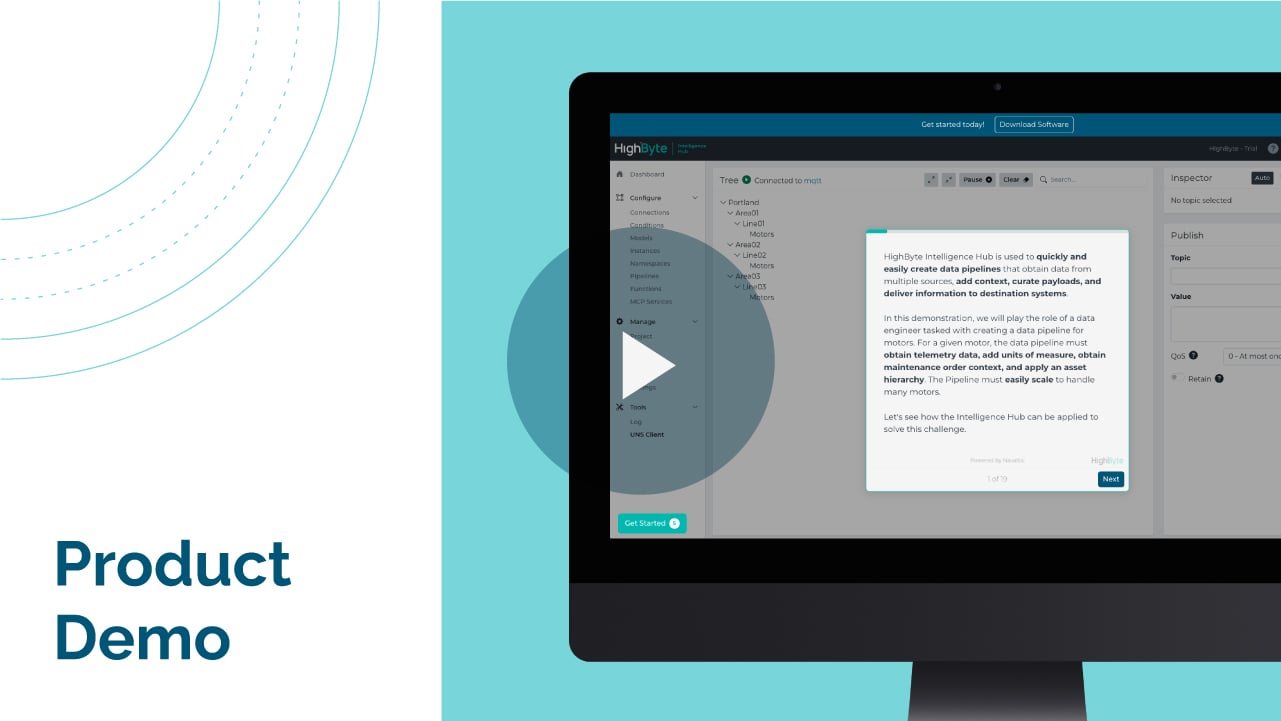
Use this guided demo to step through the process of maintaining a namespace in HighByte Intelligence Hub. Learn how to organize datasets and their relationships in a codeless, simple way.

“HighByte Intelligence Hub is crucial to our industrial data strategy. It allows us to break down silos and deliver structured data into a unified namespace.”
Brent Wassell, Principal IT Business Analyst at McNeilus, an Oshkosh Corporation Business.